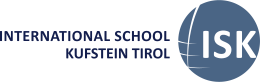

After this year’s first major trip to Strasbourg in November 2025, we focused on Brussels, the Capital of Europe, from 22nd to 26th March 2026.
An exciting programme awaited our 18 EU Junior Ambassadors and our two Senior Ambassadors, MMag. Dr Sonja Nothegger-Troppmair and Mag. Johanna Rauch. We embarked on this adventure together with 15 students and 2 teachers from our Danish partner school, HEG – Himmerlands Erhvervs- og Gymnasieuddannelser.
Our first evening in Brussels gave us the chance to explore the area around the Grand-Place, one of the most beautiful squares in the world and a UNESCO World Heritage Site. We also got into the spirit of the days ahead with a traditional Belgian dinner.
On our second day in Brussels, the ISK Tirol delegation paid a visit to the Representation of the European Region Tyrol - South Tyrol – Trentino. We were able to see how this regional cooperation works in real life, and how the region’s interests are represented at EU level. A particular highlight was meeting the two ORF Brussels correspondents, Raffaela Schaidreiter and Johannes Perterer; previously we had only seen them on radio, television or social media, so we were very excited to meet them in real life. They provided fascinating insights into their daily work, the differences between life in Brussels and Austria, and their assessment of the current political situation.
After lunch at the Euregio building, we began the afternoon programme with our Danish partner school, HEG.
At the Permanent Representation of Austria to the EU, we were given an overview of their responsibilities. These primarily involve representing Austria’s position in negotiations with European partners and keeping the Austrian Federal Government informed of the latest negotiation outcomes. After this introduction, students were able to put theory into practice in a role play. Acting as different EU member states in an EU Council working group, students had to work together to find a common solution on the issue of plastic bag use.
At the European Parliament’s Parlamentarium, our students worked in groups spanning different countries and schools, exploring the development of European cooperation and how the EU works to tackle current challenges.
In the evening, two Belgian tour guides took us on a tour of Brussels. They showed us some of the EU institution’s most important buildings in the European Quarter, and the city’s historic centre, from the Grand-Place to the Manneken Pis statue.
On our third day in Brussels, we enjoyed an interesting guided tour of the House of European History, which provided an overview of Europe’s development from the 19th century to the present day. The tour covered topics such as wars and crises, the formation of the EU, and the challenges we face today.
At the European Parliament, after a brief introduction, we joined a group discussion with Andreas Schieder, an Austrian MEP, who told us about his work.
Tyrolean MEP Sophia Kircher inspired our pupils by sharing details of her life as a politician and answering questions on issues that concern young people. She encouraged us to get involved and to maintain an interest in Europe.
On our fourth day in Brussels, we returned to the European Quarter to follow in Ursula von der Leyen's footsteps and visit the European Commission. We were given a presentation about the Commission's role. The Commission proposes legislation, implements policy and manages the EU budget. There was a strong focus on the work of EU Commissioners, especially Magnus Brunner, the Austrian Commissioner, and Dan Jørgensen, the Danish Commissioner.
After having lunch together in the European Commission's cafeteria, we moved on to visit the Council of the European Union and the European Council. There, an enthusiastic historian met us and gave us a general overview, discussed the current political situation with us, and led us to the famous glass building's red carpet.
We ended the day with a typically Belgian, transnational dinner.
On our final day in Brussels, we attended two workshops run by Visuality: one on 'sketchnotes', which is a method of taking visual notes by combining words and images; and the other on conflict management, which was based on the Gottman Method. We were thoroughly impressed by both workshops. We have benefitted from them not only in school and professionally, but also in our personal lives.
After spending such an intensive time together, it was time to say goodbye to the Danish students and teachers and set off on our return journey to Kufstein.
Thanks to our Erasmus+ project, we were able to forge intercultural friendships, develop a stronger sense of European cooperation and experience Europe first-hand on this trip.
This trip was funded by Erasmus+, the Province of Tyrol, Sparkasse Kufstein, Skillroad – the ISK Tyrol Parents’ Association – and the ISK Tyrol school authority.
Text: Johanna Rauch
Our Junior Ambassadors:
Alma Frincu, Barbara Jurleta, Conrad Gollwitzer, Jana Kharat, Linda Rödiger, Joshua Pfitzner, Lara Hinteregger, Magdalena Stöckl, Manuel Lapper, Maria Hofer, Maria-Sylvia von Rohr, Max van Vloten, Meijke Schrama, Pauline Lerch, Samuel Rockensüß, Sophia Hoffmann, Sophia Pohl, Kai Pendl.
![[Translate to EN:]](/fileadmin/_processed_/8/5/csm_TRIP_POWERED_BY_LT_SPK_SR_679d17552e.png "[Translate to EN:]")