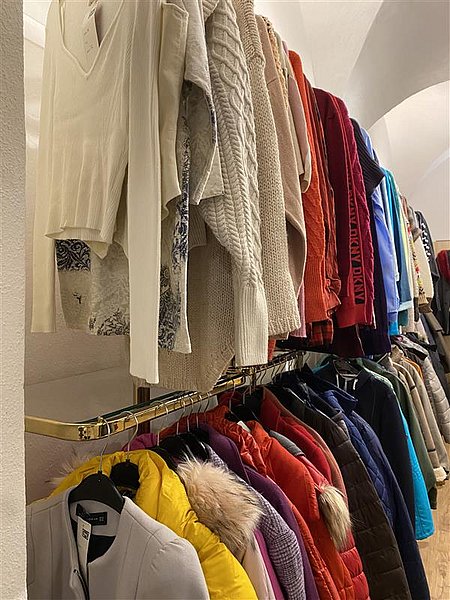

Sustainability and the careful use of resources are among the key issues of our time and increasingly shape our everyday lives. When a look into our wardrobes reveals clothes that have not been worn for a long time, the collection containers of WAMS are an obvious first point of contact for many people.
At the end of the previous school year, we collected various project ideas as part of our Religious Education lessons on how we could support the organization WAMS. An initial visit to the WAMS website (https://www.wams.at/) quickly showed that the organization does far more than simply collect clothing and pass it on to people in need. Through its WAMS shops and collection centers, WAMS is an important employer for people who are seeking to re-enter the labor market.
On 5 November 2025, classes 10A and 10B went on an excursion to Schwaz in order to gain deeper insight into the wide range of tasks carried out by WAMS. Due to the size of the group, we were divided into two groups. We were warmly welcomed both in the WAMS shop and in the collection center.
“Giving Good Items a Second Chance” (“Guten Stücken eine zweite Chance geben”) – “Second-Hand – First-Class”
During the guided tour of the WAMS shop, we were given an overview of the product range and learned how second-hand clothing is collected, sorted and prepared for sale. Particularly interesting was the realization that the idea of sustainability behind second-hand retail appeals not only to socially disadvantaged people, but also attracts many well-off customers to the WAMS shops.
“Jobs as a Springboard” (“Arbeitsplätze als Sprungbrett”)
In the collection centre, we were then given a more detailed explanation of how WAMS supports people in re-entering working life. The programme “Try it out” allows participants to get to know working at WAMS for up to six weeks. In addition, there are different employment models, such as transitional jobs with a fixed term of twelve months, where employees receive professional guidance, or assisted jobs, which can be fixed-term or last until retirement and involve taking on areas of responsibility independently. Through the various fields of work, employees gain valuable practical experience and further develop their professional skills – a decisive advantage in an increasingly competitive labour market.
Overall, the visit was very informative and clearly demonstrated the importance of organisations such as WAMS for social support, sustainable living and the responsible use of our environment.
We would like to sincerely thank Ms Altmann-Althausen and her team for the comprehensive insight into the work of the WAMS shop and the collection center in Schwaz, as well as our class teachers Sarah Reindl and Johanna Rauch for accompanying us on the excursion.
Emma-Sophie Kozlica
Stefan Höck, BSc – Teacher of Catholic Religious Education