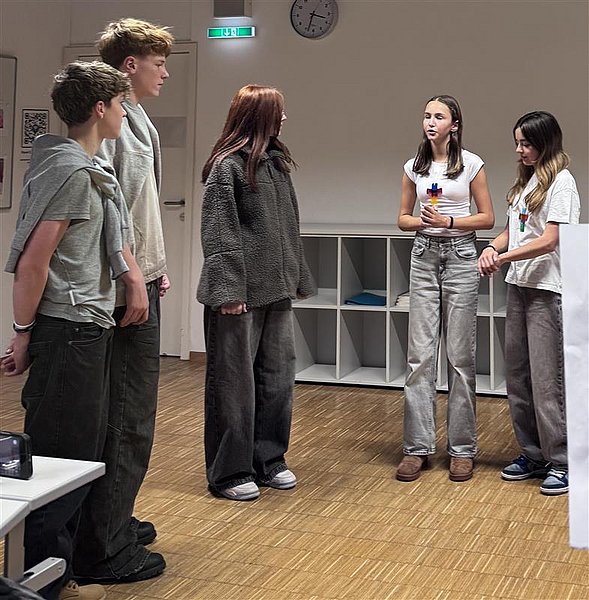

On 5 December 2025, we, class 8A, experienced the Reformation in Religious Education in a particularly vivid and engaging way. In a role play about Martin Luther, we brought key events and conflicts of the Reformation period onto the stage. Instead of learning about historical developments only from a textbook, we presented them creatively, discussed them together and “played them out” – making history come alive in the truest sense of the word.
A Topic Becomes Tangible
Working in several groups, we prepared and presented important scenes from the history of the Reformation to the class. One central focus was the moment in which Martin Luther formulated his criticism of the sale of indulgences and the 95 Theses were addressed. For us, the topic of the Reformation became particularly tangible because we did not just learn texts by heart, but developed our own roles, worked out arguments and even designed “costumes.” In this way, it became clear how strongly the Reformation was shaped by issues of power, money, fear, faith and the desire for change.
Church, Economy and Society in Conflict
A central element of our role play was a kind of panel discussion in which different interests and perspectives came into conflict. Among the characters portrayed were Pope Leo X, who defended the sale of indulgences as a necessary source of funding – for example for the construction of St Peter’s Basilica – Albrecht of Brandenburg, a heavily indebted church prince entangled in the church’s financial system, and the Fugger family, who demonstrated economic power as influential financiers. Our cast was complemented by Johann Tetzel as an indulgence preacher – and even by the figure of the indulgence letter itself, which appeared as a “commodity” promoting its own value.
A particularly striking dramatic introduction was the scene depicting the famous thunderstorm experience, which is said to have led Luther to decide to enter monastic life – complete with sound effects and an intense performance. The perspective of ordinary people was also included: the rural population appeared as a voice for social justice and highlighted the tensions between religious reform and social hardship.
Learning with Impact
The project clearly showed us how sustainable learning can be when history is not only explained, but experienced and reflected upon. We engaged intensively with questions such as:
Why was the sale of indulgences so successful? What role did fear and feelings of guilt play? What did Luther want to change? And what impact did the division of the Church have up to the present day?
Even though not all of us were actively involved in the performance, one thing became clear: the role play was a motivating and formative experience for our class – and an example of how Religious Education can make historical topics not only understandable, but truly tangible.
Julius Petzer (8A)
Stefan Höck, BSc – Teacher of Catholic Religious Education